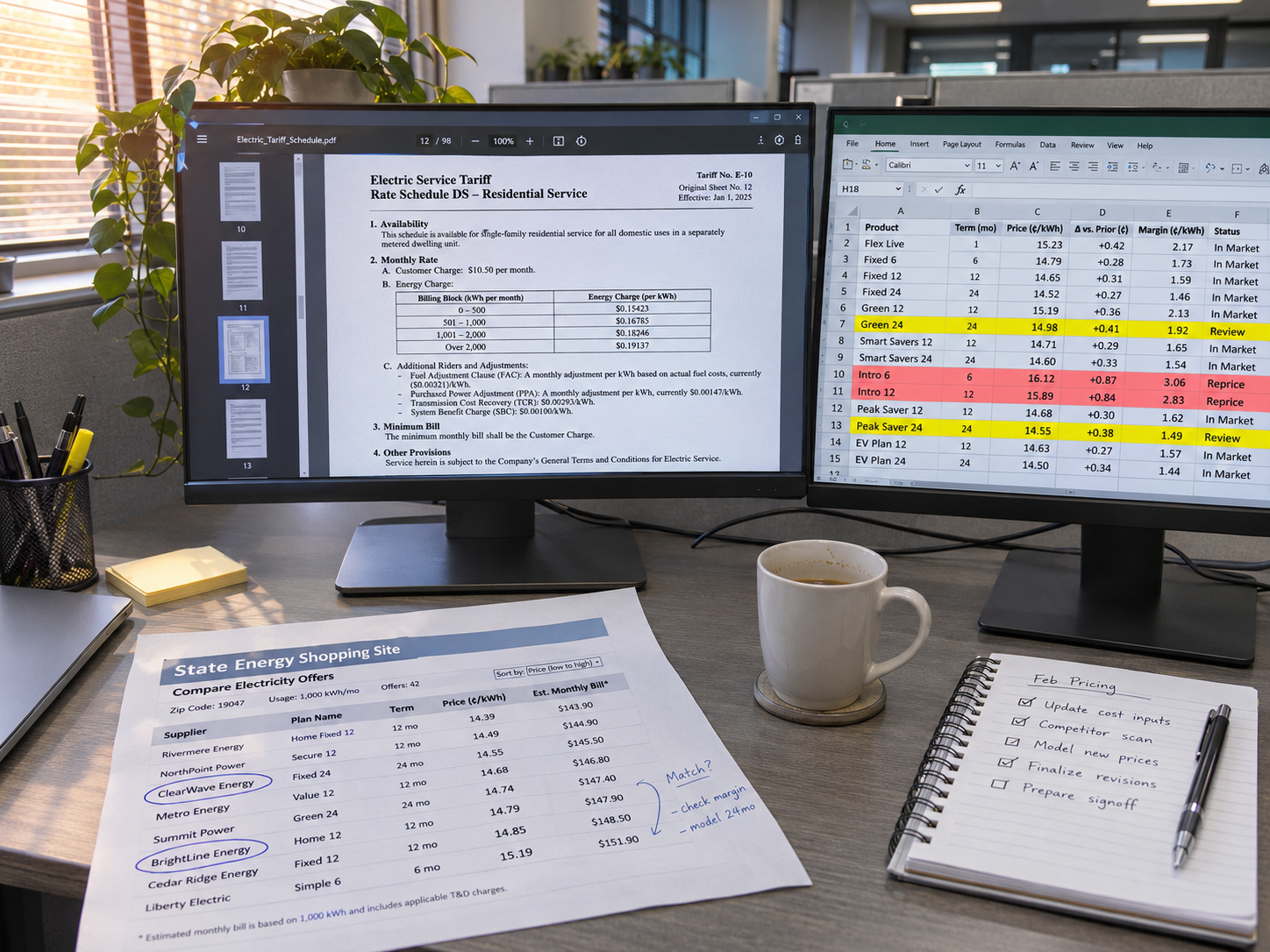
Every offer a retail energy supplier makes is measured against one number: the utility’s price to compare.
It’s the threshold customers see when they shop. It’s the benchmark regulators reference. And it’s the line your pricing team builds every matrix around. But for something this central, most suppliers still track it by hand — and that creates problems that compound quietly over time.
What the price to compare actually is
The price to compare (PTC) is the default utility rate a residential or commercial customer will pay if they don’t choose a competitive supplier. It’s stated as a per-kWh number, published by the utility, and broken out by rate class.
It’s not a fixed number. Utilities reset it on their own schedules — some monthly, some quarterly, some only when a rate case settles. When it moves, every supplier’s competitive position shifts with it.
Why it matters for acquisition and retention
Acquisition: When your offer is below the PTC, the pitch is simple — you’re cheaper than the utility default. When it’s above, you need a reason (green energy, fixed rates, bundled services). Either way, you need to know where you stand.
Retention: When a PTC drops, the utility default gets cheaper. Customers on your fixed-rate plan suddenly have a lower-priced alternative they didn’t choose. If you’re not watching, you find out when the cancellation notices come in.
Why it’s hard to keep up with
In theory, the PTC is public information. In practice, keeping it current across every utility and rate class you serve is a grind:
- Rates are buried in tariff PDFs, utility websites, and state commission filings — each formatted differently.
- When a utility updates its PTC, the old number disappears. There’s no archive unless you built one.
- Competitive offers live on separate state shopping sites, each with its own layout and update cycle.
- Nobody sends you a notification when a rate changes. You find out by checking — or by losing a deal.
None of this is hard work. It’s just slow, it’s easy to get wrong, and it never stops.
The cost of not comparing
So you know what the price to compare is, why it matters, and why keeping up with it is a grind. Most suppliers stop there — they pull today’s number and move on. But a single snapshot is where the real cost hides:
- No history means you can’t see how a utility’s PTC has trended, so you’re pricing against a point in time instead of a pattern.
- No competitive view means you don’t know what other suppliers are actually offering on the state shopping sites — just what your own sales team reports back.
- No margin visibility means you’re leaving money on the table in markets where you could price higher, and bleeding customers in markets where you’re too close to the line.
The math is simple: pricing 0.5¢ per kWh lower than you needed to costs $5 a month, or $60 a year. Across 10,000 customers, that’s $600,000 a year. The same half-cent the other way, priced too high against a PTC that just dropped, is how renewals walk out the door.
A simpler way: the PTC API
The ennrgy.com PTC API puts that work in one versioned feed, in the same format for every state. It has three parts:
- Price to Compare: current residential and commercial rates for 46 utilities and 161 rate classes in 12 states and DC. Every rate links to the utility’s source document, so you can always check the number.
- Historical: every version of every rate, never overwritten. That’s 1.8 million records today, so you can see how a utility’s PTC has moved and plan renewals around it.
- Competitive: current supplier offers from 10 official state shopping sites, including Texas.
Because it’s an API, it works with the systems you already use: your pricing models, retention tools or reporting. There’s no new platform to adopt.
If you price with ennrgy.com, the same data feeds our Unified Pricing Platform, where the PTC sits right on your daily matrix. If you don’t, the API stands on its own, and the platform is there when you want more.
Know the price you’re up against
The price to compare is the one number every retail offer is judged against. Tracking it shouldn’t take a spreadsheet and a free afternoon every month.
See what’s in the feed, or request a free PTC data sample for one utility territory, on the Price to Compare page.
See Price to Compare in Action
Current PTC rates, full history, and competitive offers — one feed that works with your existing systems.