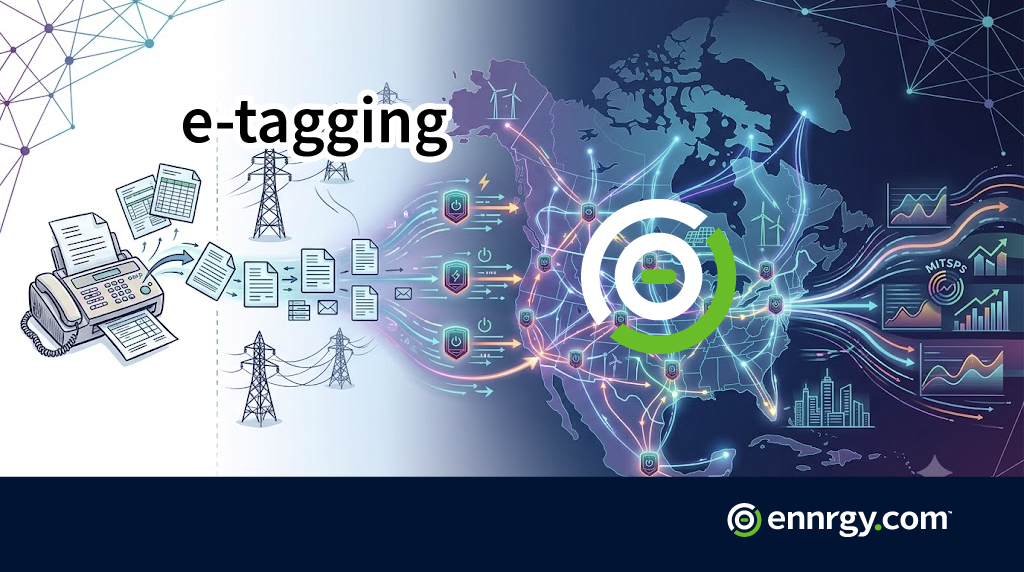
In 1997, moving power across a grid boundary meant spreadsheets, phone calls, and faxes. A scheduling desk would fill out an Excel template, fax it to every balancing authority along the transmission path, and wait for callbacks.
Two years later, NERC replaced that entire process with electronic tagging. The North American grid hasn’t looked back.
What an e-tag actually is
An e-tag is an electronic message that tracks an energy interchange transaction between balancing authority areas. Every time power moves from one BA to another anywhere in North America, an e-tag goes with it.
The tag carries everything the grid needs to know about the transaction. Source and sink balancing authorities. Energy profile in megawatts. Transmission service reservations. Curtailment priority. The physical path the power will follow.
Think of it as a shipping manifest for electrons.
NERC requires e-tags for all interchange transactions under its reliability standards. NAESB governs the data protocols and message formats. Together, they keep 300+ balancing authorities in sync across the continent.
How we got here
NERC launched electronic tagging on September 22, 1999. It replaced a manual system that had been running since the mid-1990s.
The improvement was immediate. Processing times dropped. Error rates fell. For the first time, reliability coordinators could see scheduled interchanges in something close to real time.
The spec has evolved steadily since. Version 1.7 added dynamic scheduling for variable generation sources. Version 1.8.1 arrived in 2009 with improved error handling. The current version, 1.8.4, was approved in February 2020 with support for multi-region transactions.
NAESB took over governance of the data standards in 2002, working alongside NERC’s reliability standards. Today the system handles thousands of transactions daily across every interconnected grid in North America.
SoftSmiths has been part of that story from the beginning. We’re a contributing author to the NERC eTag specification, and we’ve participated in every version of electronic tagging since the days when tags moved by email.
Why it’s getting harder
The basic concept hasn’t changed. Submit a tag, get approvals from every entity along the path, manage the transaction through its lifecycle.
But the complexity has compounded.
NERC’s INT-006 standard requires balancing authorities to evaluate and approve or deny interchange transactions within defined timeframes. Miss the window and the transaction doesn’t happen. That puts real pressure on scheduling desks, especially during peak hours when dozens of tags need simultaneous processing.
Tags must go in at least 20 minutes before the operating interval. Every tag passes through a multi-party approval workflow involving source and sink BAs, transmission providers, and reliability coordinators. Each entity validates technical feasibility, transmission availability, and reliability impacts.
The grid keeps adding layers. Dynamic e-tags accommodate variable renewable generation with near real-time profile updates. Emergency e-tags support urgent reliability situations. Capacity e-tags handle reserve imports. Each type follows its own rules and coordination requirements.
Every time a megawatt crosses a grid boundary in North America, an e-tag goes with it. Thousands of transactions a day, each requiring multi-party approval within strict NERC timeframes.
And there’s a deadline on the horizon. SPP Markets+ launches in October 2026. The Southwest Power Pool’s new market brings fresh e-tagging workflows and scheduling requirements through its MITSPS system. Every entity doing business in SPP will need to adapt.
For a mid-sized REP or utility running a lean scheduling desk, keeping up with all of this is a full-time job. Several, actually.
When your desk can’t keep up
Most scheduling desks handle their own e-tagging fine when volumes are low and transactions follow standard patterns. Firm point-to-point. Same path. Same counterparties.
It’s the exceptions that create problems.
Non-firm transactions with variable curtailment priorities. Dynamic schedules tied to renewable output. Multi-segment paths crossing four or five balancing authorities. Transmission loading relief events that demand rapid curtailment decisions.
When your scheduling team is also handling nominations, procurement, and settlements, e-tagging mistakes start showing up. Wrong curtailment priority on a tag. Missed approval window. Reservation that doesn’t match the tag path.
These aren’t theoretical risks. NERC audits compliance with INT standards, and violations carry penalties. FERC monitors transaction data for anomalies.
A managed e-tagging service takes the entire workflow off your desk. Submission, approval tracking, profile adjustments, curtailment response, and compliance documentation. Your team stays focused on trading and risk while experienced power schedulers handle the interchange mechanics.
How we do it
We provide NERC and NAESB-compliant e-tagging across 9 ISOs and RTOs in the US and Canada: PJM, ERCOT, NYISO, ISO-NE, MISO, SPP, CAISO, IESO, and NBSO.
Our team handles reservation management through eReservation, path accounting, loss tracking, and transmission coordination through OASIS. We’ve built eTag templates for common transaction types, so recurring transactions take minutes instead of hours.
For companies with existing trading systems, our eLink API provides bi-directional integration. Your ETRM submits trades. The e-tags flow automatically.
All of this runs inside Risk360, so your scheduling, e-tagging, and settlement data live in one place. No reconciling across disconnected systems.
E-tagging is one of those things you don’t think about until something goes wrong. We’d rather you never have to think about it at all.
Take e-tagging off your desk
NERC and NAESB-compliant interchange scheduling across 9 ISOs and RTOs. Managed by power schedulers who’ve been doing this since the fax machine days.