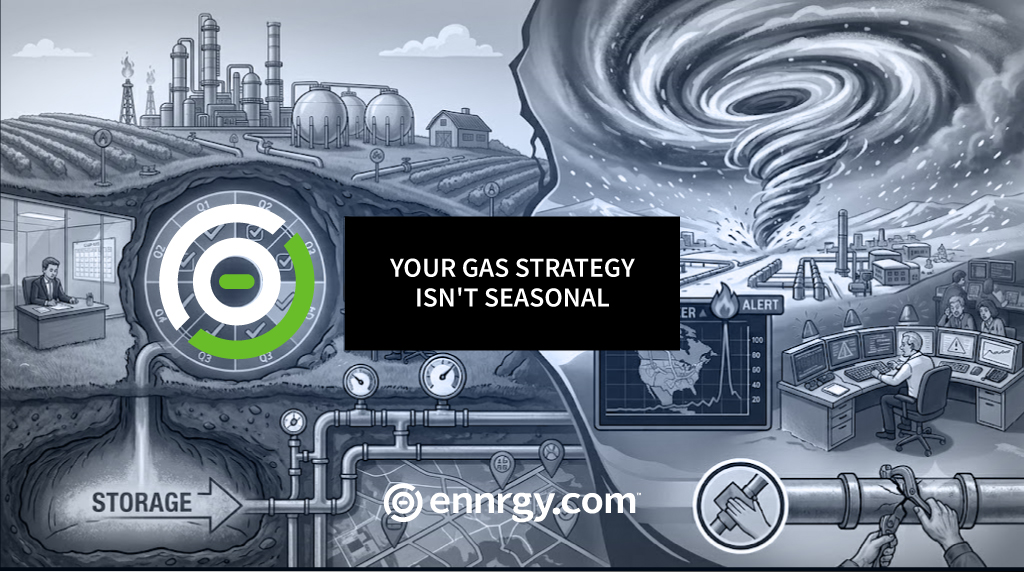
Most gas suppliers treat summer and winter like separate operating seasons. Both are shaped by decisions made months earlier, in the quiet periods when nobody’s panicking.
The companies that come out of a polar vortex intact didn’t get lucky. They planned for it in September.
Summer is setup season
When heating demand drops off and prices soften, a lot of gas teams exhale. That’s the wrong instinct.
Summer is injection season. It’s when you build the storage position that gives you flexibility in January. Miss that window, or fill it at the wrong price points, and you’re buying spot in February when everyone else needs gas too.
It’s also when you should be stress-testing your pipeline portfolio. Which receipt and delivery points are costing you money? Where are you paying for capacity you’re not using?
The market is calm enough in July to ask those questions clearly. In January, you’re too busy surviving to ask them.
Run your 30-day weather-responsive forecast through summer too. It tells you which customers have load profiles that will cause problems when the cold arrives.
Find that out in August and you can act on it. Find it out in December and you’re managing damage.
What a polar vortex actually costs
Last winter, gas prices hit $80 to $100 per dekatherm at certain pipeline points. Those numbers sound abstract until you work through the math.
OFO penalties on most pipelines run at 10x the gas daily average. Every dekatherm outside the band.
When daily average prices are $80, that penalty is $800 per dekatherm. If your nomination was off by 100 dekatherms, that’s $80,000. On a bad day. On a single pipeline.
The suppliers who absorbed those costs weren’t necessarily negligent. Some of them had reasonable forecasts. They just didn’t have the visibility to catch the imbalance before the penalty window closed.
One of our clients got ahead of it. Our forecasting flagged the December 2025 cold snap early, and we recommended they run 100% of contracted pipeline capacity before prices moved. They did. Average COGS dropped $1.70 per dekatherm. We published the full breakdown.
Position visibility by Tuesday morning, before nominations close. Everything after that is just bookkeeping.
The nomination window doesn’t move for you
Every pipeline has its own rules. Different utilities, different LDCs, different submission windows, different balancing tolerances. Some accept intraday nominations. Some don’t. Get the timing wrong on the ones that don’t, and you’ve lost your adjustment opportunity for the day.
This is the part of gas operations that doesn’t get enough attention in strategy conversations. The tactical layer (the daily discipline of nominations, balancing, and imbalance monitoring) is what makes or breaks your seasonal plan.
You can have the right storage position, the right hedges, the right supply contracts. And still lose money in January because someone missed a 10 a.m. nomination window on a Tuesday when your demand forecast was off by 15%.
What Indra Energy figured out
Indra Energy runs gas and electric across multiple states. When extreme market conditions hit, they didn’t scramble. Sariah Pena, their VP of Gas Supply and Operations, put it plainly: strategic planning and real-time visibility gave them the confidence to focus on growth while the operations ran.
They moved from spreadsheet-driven workflows to a live position view, replaced manual data entry with automated deal processing, and put an experienced gas team on daily nominations. Their internal staff went back to the dozen other things on their plate.
When the volatile stretch arrived, the decisions had already been made. The only thing left was execution.
What good seasonal planning actually looks like
Spring is the time to review your storage matrix: which facilities, what injection targets, what price triggers. Summer is when you execute those injections and monitor the pipeline points that need repositioning. Fall is when you layer in your winter hedges and run your demand scenarios for cold weather extremes.
By the time November arrives, your position should be set. December is execution. You run the plan you built in September.
A few specifics worth building into that calendar:
WACOGS should be live, not a month-end calculation. If you’re discovering margin problems in a spreadsheet after the period closes, you’re fixing the last quarter, not managing this one.
Weather forecasting at the utility and customer level, 30 days out, gives you enough lead time to adjust nominations before you’re in penalty territory.
Storage withdrawals need to be paced against your demand curve. Companies that drain storage by February because they didn’t model their winter load correctly are the ones buying $100 gas in March.
The team behind the plan matters as much as the plan
Gas operations has a knowledge problem. The expertise required to manage nominations across 10 utilities, balance storage across multiple pipelines, and catch imbalances before they become write-offs isn’t evenly distributed. It’s concentrated in people who’ve done this work for decades.
Hiring that team in-house is expensive. Keeping them engaged through the slow months is harder. And if your key gas scheduler takes a vacation in January, you have a real problem.
The model that works for most gas suppliers is an experienced managed services operation, running inside your platform, covering the desk 365 days a year, with 50+ years of collective gas operations experience behind every nomination.
The desk doesn’t close because it’s a holiday. The nominations go in because someone who’s done this for 20 years knows exactly when they need to go in and what happens if they don’t.
The window to prepare is now
If you’re reading this and summer has already started, you still have time. The storage injection window runs through October. Pipeline capacity decisions for winter can still be made. Demand scenarios can still be stress-tested.
But the window closes faster than most teams expect. By the time October feels urgent, the best injection prices are behind you and the capacity market has moved.
The suppliers who handle winter well plan in the spring. The ones who handle it poorly start planning in November.
Ready to talk about your gas operations before the next season hits?
Our gas team walks through the specifics with you in 30 minutes. No commitment required.
About the author. Michael Parrella is CEO of ennrgy.com. The company’s Risk360 platform and managed gas services team covers nominations, balancing, WACOGS analysis, storage optimization, and settlement reconciliation for gas suppliers and dual-commodity retailers across the U.S.